
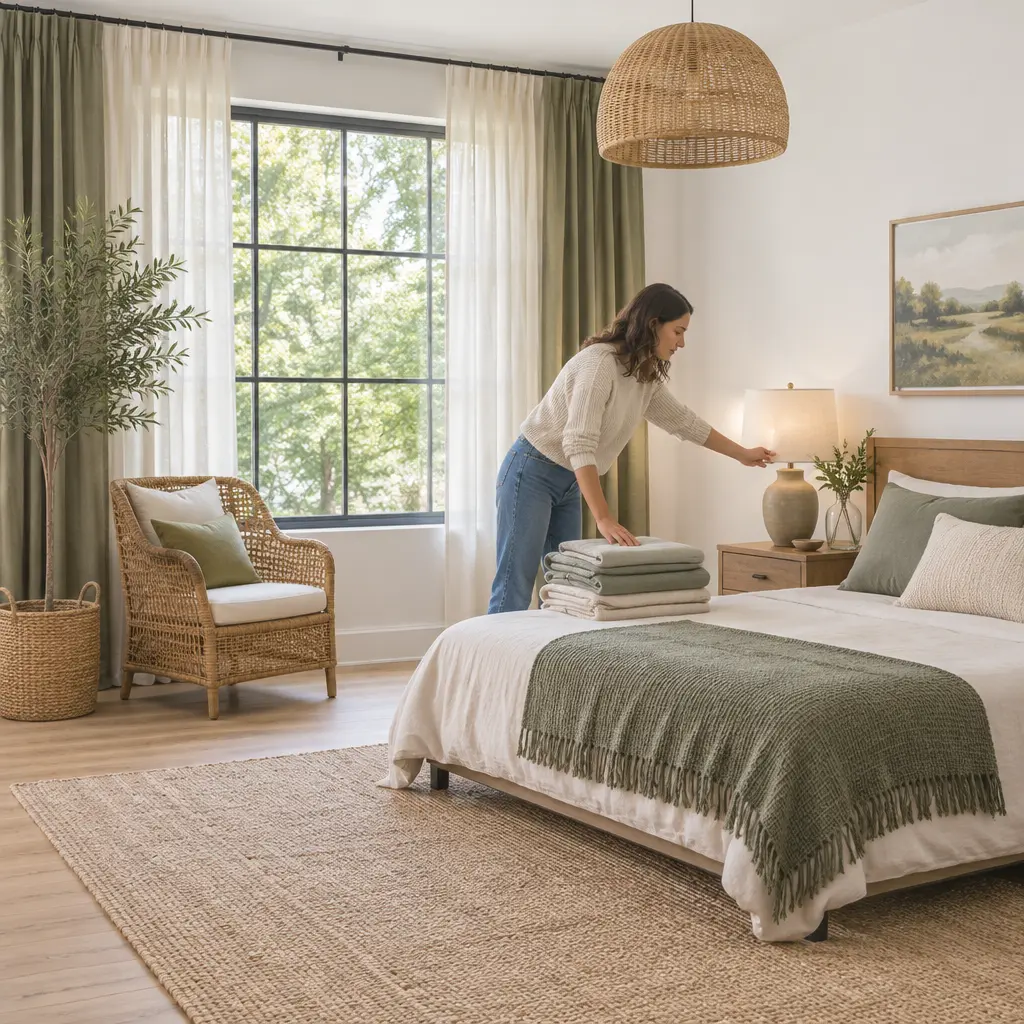
A bedroom sanctuary is a sleep-oriented environment designed to support comfort, reduce disruptive sensory input, and make healthy routines easier to maintain. Its performance depends on more than décor: light timing, temperature, noise, air quality, bedding, and room layout all influence sleep conditions. The Centers for Disease Control and Prevention recommends that adults get at least seven hours of sleep per night, while the National Sleep Foundation’s bedroom guidance emphasizes a cool, dark, quiet setting. This guide explains how to engineer those conditions through material choices and layered lighting, then shows how to apply them in a practical bedroom plan.
Bedroom sanctuary design defines a sleep-supportive environment
A bedroom sanctuary is a room intentionally arranged to support sleep and recovery rather than one that merely looks restful. The American Academy of Sleep Medicine and Sleep Research Society recommend that adults regularly sleep seven or more hours; adequate sleep is associated with health and daytime functioning, while persistent short sleep is a public-health concern. Room design cannot treat sleep disorders or replace medical care, but it can reduce environmental barriers such as excessive light, uncomfortable temperatures, noise, and unsuitable bedding.
The main design variables are interdependent. Blackout curtains can reduce incoming light, for example, but they do not correct a noisy street or an overheated room. A comfortable mattress may help with physical comfort, yet bright evening light can still interfere with the body’s preparation for sleep. A useful design therefore treats the bedroom as a system: control light, stabilize comfort, limit disturbance, and keep the space easy to use consistently.
Sleep-supportive design begins with measurable conditions
Sleep-supportive design means choosing room conditions that make it easier to fall asleep, remain asleep, and wake at a desired time. The National Sleep Foundation describes a cool, dark, and quiet bedroom as a helpful foundation. These are practical targets rather than guarantees: individual preferences, health conditions, age, climate, and sleep schedules differ, and no single bedroom temperature or product works for everyone.
Start with observation rather than assumptions. Note when direct sunlight enters, whether streetlights reach the bed, which sounds interrupt sleep, and whether the room feels warm or cold overnight. A simple thermometer, a week of sleep notes, and a nighttime walk-through can identify the strongest sources of disturbance before money is spent on furnishings.
Bedroom conditions connect to wider health priorities
Sleep is a basic health behavior, not a luxury amenity. The CDC reports that adults should get at least seven hours each night, while the American Academy of Sleep Medicine and Sleep Research Society note that regularly sleeping less than seven hours is associated with adverse health outcomes. These recommendations make bedroom design relevant to public health as well as comfort, although room improvements should be considered supportive measures, not a substitute for clinical assessment when sleep problems persist.
Bedroom lighting design shapes the sleep-wake environment
Bedroom lighting design is the planned use of daylight, electric light, and light-blocking materials to support daytime alertness and nighttime rest. The National Institute of General Medical Sciences explains that circadian rhythms are physical, mental, and behavioral changes that follow an approximately 24-hour cycle and respond primarily to light and darkness. That makes the timing and direction of bedroom light as important as its brightness: daylight can help anchor daytime routines, while bright light late in the evening may work against the normal transition toward sleep.
A useful lighting plan separates daytime exposure, evening wind-down, and nighttime navigation. The goal is not to keep a bedroom dark all day, but to make darkness reliable when sleep is intended and to avoid unnecessary glare during the pre-sleep period. The following categories—daylight control, electric-light layering, and night lighting—work together rather than as competing solutions.
Daylight control uses windows and light-blocking layers
Daylight control is the management of outdoor light entering through windows. Light-blocking curtains, lined drapes, cellular shades, and well-fitted blinds can reduce early-morning sun, streetlight intrusion, and glare. For renters or people who do not want permanent changes, a removable blackout liner or a comfortable sleep mask may be a practical alternative. Choose a system that can be opened fully during the day so the room does not remain unnecessarily dim.
Pay attention to edge leakage around curtain panels and the top of a window covering. A dark-looking fabric does not necessarily block all light, so test the treatment at the actual time of disturbance. Where daytime sleep is necessary, such as for shift workers, stronger room-darkening measures may be especially useful; the room should still be arranged to allow safe movement and ventilation.
Layered electric lighting supports different evening tasks
Layered lighting combines ambient light for general visibility, task light for activities such as reading, and accent or low-level light for orientation. This arrangement lets occupants reduce overall brightness as bedtime approaches without making ordinary tasks difficult. A dimmable bedside lamp with a shade can be more comfortable than relying on a bright ceiling fixture, while switches within reach of the bed reduce the need to cross a dark room.
Color temperature describes the apparent warmth or coolness of a light source, usually expressed in kelvins, but it should not be treated as the only measure of circadian impact. Brightness, duration, timing, distance, and personal sensitivity also matter. Use the lowest comfortable brightness for evening tasks, avoid shining lamps directly toward the eyes, and consider reducing bright screen exposure before bed. The National Institute of General Medical Sciences identifies light as a major influence on circadian timing; it does not imply that a particular bulb color alone guarantees better sleep.
Night lighting balances orientation with darkness
Night lighting is low-level illumination used for safe movement without fully lighting the room. A shielded floor-level guide light, motion-activated path light, or very dim bedside lamp can help people navigate to a doorway or bathroom. Keep the source out of direct sightlines from the pillow and avoid leaving bright lights on throughout the night when they are not needed.
For people who wake frequently, test whether the light can be activated only when needed and positioned to illuminate the floor rather than the face. This small design decision connects visual safety with the broader aim of preserving a dark sleep environment.
Bedroom materials engineer comfort, sound, and air quality
Bedroom materials are the surfaces and products—mattress, bedding, window coverings, flooring, wall finishes, and furnishings—that shape tactile comfort, heat transfer, sound, and indoor air. Their performance depends on the whole assembly, not a label such as “natural,” “cooling,” or “hypoallergenic.” The U.S. Environmental Protection Agency notes that indoor air quality can be affected by pollutant sources, ventilation, and occupant activities; choosing furnishings and finishes therefore involves both comfort and sensible source control.
Material selection should begin with the problem being solved. If the bed feels hot, assess bedding layers and airflow before replacing the mattress. If sound is disruptive, soft furnishings may reduce some reflections, but they cannot provide the same isolation as sealing gaps or improving the building envelope. This distinction helps keep design claims realistic and directs effort toward the relevant hyponyms: thermal comfort, acoustic control, and indoor-air-conscious finishes.
Bedding and mattress choices affect tactile and thermal comfort
Thermal comfort is the personal sense of being neither too warm nor too cold. Mattress construction, mattress protectors, sheets, blankets, sleepwear, and room temperature all contribute. Breathable, washable bedding and adjustable layers allow occupants to adapt to seasonal changes and individual differences. Material names alone do not establish performance: weave, thickness, fit, moisture management, and the sleeper’s preferences can matter as much as fiber content.
Choose a mattress that supports a comfortable sleeping posture and suits the user’s body and mobility needs; there is no universally best firmness. If a mattress is sagging, painful, or unsuitable, evaluate it directly rather than expecting decorative changes to solve the problem. A mattress protector should fit securely and be easy to clean, while blankets should be simple to add or remove without creating excess heat.
Soft surfaces can reduce room reflections but not replace sound isolation
Acoustic treatment uses furnishings and surface finishes to manage sound inside a room. Rugs, curtains, upholstered furniture, and fabric bedding can absorb some reflected sound and make a room feel less echoing. They generally do not block substantial sound transmission through walls, windows, doors, or floors. For external noise, practical measures may include sealing obvious air gaps, improving window treatments, using a door sweep where appropriate, or asking a qualified professional about building-level options.
White-noise or sound-masking devices may help some people by making intermittent sounds less noticeable, but they are not necessary for everyone. Keep any device at a comfortable volume and use it only if it improves the sleep environment. Persistent or unusually disruptive noise may require a source-level solution rather than adding more soft furnishings.
Finishes and ventilation influence indoor air conditions
Indoor-air-conscious material selection means limiting avoidable pollutant sources while maintaining suitable ventilation and routine cleaning. The EPA identifies indoor air quality as a product of sources, ventilation, and occupant behavior; furnishings, cleaning products, and building materials can all contribute to indoor exposures. When buying new items, follow manufacturer instructions for installation and airing out, avoid using strongly scented products to mask odors, and maintain heating, ventilation, and air-conditioning systems as recommended.
Dust control is also part of material performance. Washable bedding, accessible floor surfaces, and regularly cleaned window coverings can make routine maintenance easier. People with allergies, asthma, or chemical sensitivities may need individualized advice from a healthcare professional or indoor-air specialist; broad marketing claims should not replace that guidance.
Bedroom temperature and layout turn design principles into daily practice
Bedroom thermal conditions and layout determine whether a sleep-supportive plan works in everyday use. A room can be visually calm yet uncomfortable if it traps heat, blocks airflow, or forces occupants to navigate around clutter. The National Sleep Foundation recommends a cool sleep environment, but the preferred temperature varies by person, bedding, climate, and health. Use comfort and reliable measurement—not a single universal number—as the guide.
Temperature management combines room controls and bedding
Temperature management is the adjustment of room conditions and sleep layers to maintain individual comfort through the night. Begin by checking the room near the bed at bedtime and, if possible, during the night. Adjust thermostat settings, airflow, bedding weight, and sleepwear in small steps. Keep vents unobstructed and avoid directing uncomfortable drafts toward the sleeper.
If the room remains too warm, investigate heat sources such as direct afternoon sun, electronics, or inadequate ventilation. If it is too cold, adjustable layers may be more practical than overheating the entire home. A simple one-week log of temperature, bedding, awakenings, and morning comfort can reveal which change is helping.
Furniture placement protects access, airflow, and routine
Bedroom layout is the arrangement of the bed, storage, lighting, and circulation paths. Place the bed where window light and drafts are manageable, while leaving a clear route to the door and essential furnishings. Keep bedside controls, water, glasses, and reading light within convenient reach when needed. Reducing clutter can also make cleaning easier and prevent obstacles during nighttime movement.
Where possible, separate sleep from work, exercise, and screen-heavy activities. This is a behavioral design strategy rather than a strict rule: small homes may require a room to serve multiple purposes. In that case, use visual or functional cues—such as putting away a laptop, closing storage, or switching to a softer lamp—to mark the transition to the sleep routine.
A practical bedroom sanctuary plan prioritizes the largest disruptions
A practical plan begins with the disturbance that most often interrupts sleep, then tests changes one at a time. This avoids expensive redesigns based on assumptions and makes it easier to identify what actually improves comfort. The following sequence can be adapted to a rented room, a shared bedroom, or a full renovation.
- Observe the room for several nights: record light intrusion, noise, temperature, and comfort at bedtime and on waking.
- Address low-cost, high-impact issues first, such as a bright indicator light, an uncovered window, a blocked vent, or a lamp that is too harsh.
- Improve bedding and mattress comfort based on the sleeper’s actual needs, not product claims alone.
- Reduce avoidable noise and clutter, and make the route to the bed and door safe and clear.
- Reassess after a week or two, changing one major variable at a time so the effect is easier to judge.
For example, a person waking before sunrise might first test a better-fitting blackout treatment and move a bright clock display out of view. Someone disturbed by traffic might combine gap sealing with a heavier curtain while recognizing that fabric alone will not soundproof a window. A hot sleeper might try lighter bedding and improved airflow before investing in a new mattress. These are illustrative applications of the design principles, not claims that a particular intervention has been proven to cure insomnia.
If sleep difficulty continues despite a suitable environment, or if there is loud snoring, gasping, severe daytime sleepiness, or persistent insomnia, seek advice from a healthcare professional. Bedroom design can support healthy sleep habits, but it cannot diagnose or treat underlying conditions.
Conclusion: bedroom sanctuary design makes sleep conditions intentional
Bedroom sanctuary design combines sleep-supportive conditions, circadian-aware lighting, comfortable and maintainable materials, sensible temperature control, and a clear layout. Light should be usable during the day and limited when darkness is needed; materials should address real comfort, sound, and air-quality concerns; and room changes should be tested against the sleeper’s experience. These choices matter because adults are recommended to obtain at least seven hours of sleep, yet design remains one supportive part of a larger picture of health.
Begin with a simple nighttime audit, correct the most disruptive condition, and make one change at a time. For further guidance, consult public-health sleep recommendations and seek clinical support when sleep problems persist.
Sources: Centers for Disease Control and Prevention, About Sleep, https://www.cdc.gov/sleep/about/index.html; Watson, N. F., et al., Recommended Amount of Sleep for a Healthy Adult: A Joint Consensus Recommendation of the American Academy of Sleep Medicine and Sleep Research Society, Journal of Clinical Sleep Medicine, https://jcsm.aasm.org/doi/10.5664/jcsm.4758; National Sleep Foundation, Bedroom Environment, https://www.thensf.org/bedroom-environment/; National Institute of General Medical Sciences, Circadian Rhythms, https://www.nigms.nih.gov/education/fact-sheets/Pages/circadian-rhythms.aspx; U.S. Environmental Protection Agency, Introduction to Indoor Air Quality, https://www.epa.gov/indoor-air-quality-iaq/introduction-indoor-air-quality.