
Luxury furniture shopping online and in showrooms involves balancing convenience, confidence, and the ability to judge a piece before buying. Online retailers offer broad selection, detailed product information, and home delivery; showrooms let shoppers see materials, assess comfort, and speak with sales staff in person. The right choice depends on the item, the reliability of the seller, delivery and return terms, and how much uncertainty you are willing to accept. That decision matters in a market where furniture is a substantial household purchase: the U.S. Bureau of Labor Statistics’ Consumer Expenditure Survey reported average annual household spending of $681 on furniture in 2022, while luxury pieces can cost far more. Comparing product evaluation, price, logistics, and consumer protections helps buyers choose a channel with fewer surprises.
Luxury furniture buying channels: online versus showroom
A buying channel is the route through which a customer discovers, evaluates, purchases, and receives a product. For luxury furniture, the two main channel types are digital commerce—brand websites, online marketplaces, and virtual consultations—and physical retail, including brand showrooms and multi-brand design stores. The U.S. Census Bureau defines e-commerce sales as sales of goods and services where the order is placed over the internet, regardless of how payment is made or how delivery occurs. That definition distinguishes the purchase channel from fulfillment: an online order may still be delivered by a specialist crew, while a showroom purchase may be shipped directly from a warehouse.
The National Retail Federation and other retail researchers describe modern shopping as increasingly omnichannel: customers may research online, visit a showroom, and complete the purchase through either channel. For high-value furniture, this blended approach is especially useful because digital tools support comparison while in-person inspection addresses questions that photos cannot fully answer. The key characteristics to compare are product verification, price transparency, customization, delivery, returns, and after-sales support.
Online luxury furniture shopping
Online shopping means selecting and ordering furniture through a website or digital sales platform. It can provide access to more models, finishes, and vendors than a nearby store, often with searchable specifications and customer reviews. The U.S. Census Bureau reported that e-commerce accounted for 16.1% of total U.S. retail sales in 2024, illustrating how established digital purchasing has become; that figure covers all retail categories, not luxury furniture specifically.
For furniture, useful online details include overall dimensions, seat height and depth, frame and upholstery materials, construction methods, finish samples, care instructions, lead times, and delivery scope. A listing that says “white-glove delivery” should explain whether the service includes room placement, assembly, packaging removal, and access-related charges. Reviews can reveal recurring issues, but buyers should distinguish verified-purchase feedback from unverified comments and check whether reviews refer to the exact configuration being considered.
Showroom luxury furniture shopping
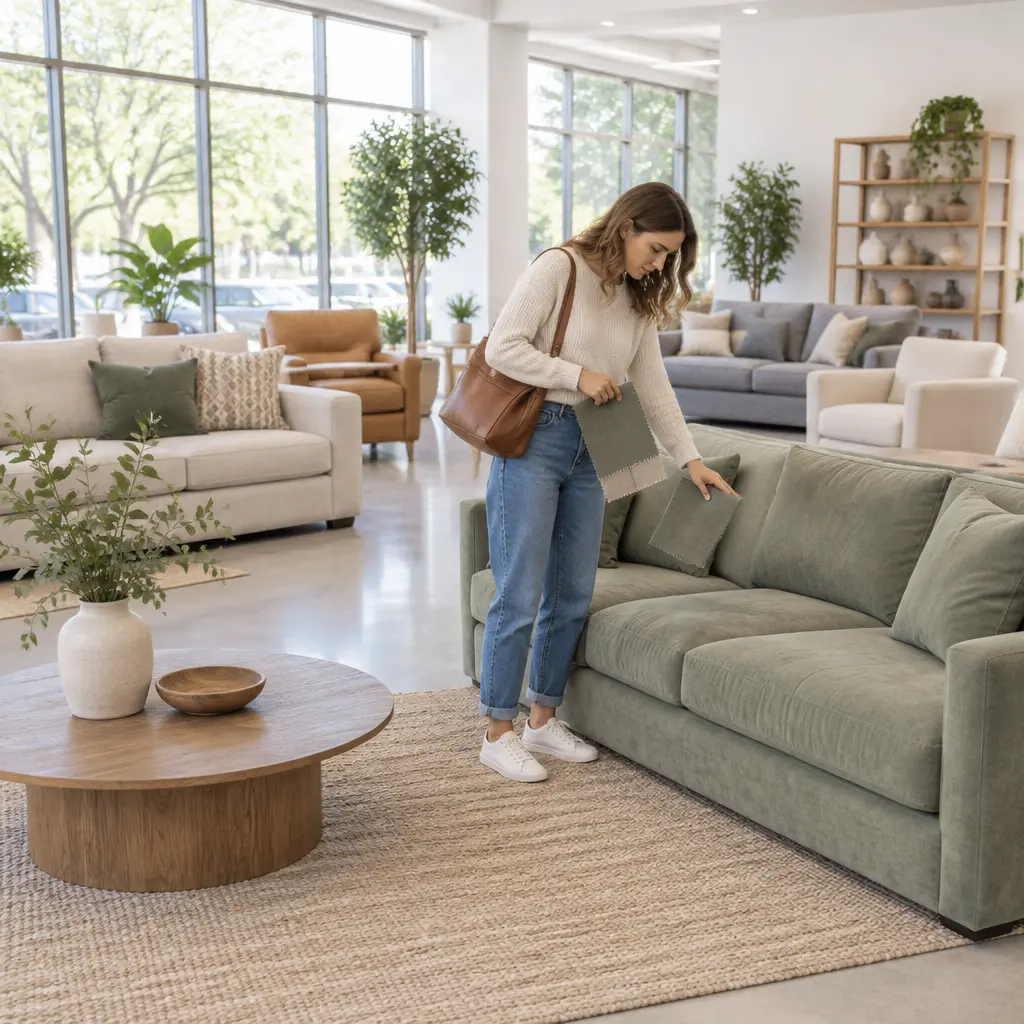
A showroom purchase involves evaluating furniture at a physical retail location, either before buying there or after researching online. It lets shoppers see color and texture under real lighting, test seating comfort, inspect joinery and finishes, and ask questions about construction or customization. These advantages are particularly relevant for sofas, mattresses, dining chairs, and pieces with distinctive materials or complex dimensions.
A showroom visit is not a guarantee that the displayed item is identical to the delivered piece. Floor models may differ in upholstery, finish, age, or condition, and made-to-order goods may come from a separate production run. Buyers should ask whether the displayed configuration matches the quote, request written specifications, and confirm whether the item is in stock, made to order, or available only as a sample.
Product evaluation and quality verification
Product evaluation is the process of determining whether a furniture item’s dimensions, materials, comfort, construction, and appearance suit the buyer’s needs. The American Society for Testing and Materials (ASTM International) develops voluntary consensus standards used across industries, including standards relevant to furniture performance and safety. Standards and certifications can inform a decision, but they do not replace checking the exact product, intended use, and warranty.
Materials, finish, and construction
Materials and construction describe what a piece is made from and how its components are assembled. In person, buyers can inspect veneer edges, seams, stitching, cushion recovery, hardware, and finish consistency. Online, seek specific descriptions rather than broad terms such as “solid wood” or “premium leather”: ask which parts are solid wood, what species is used, whether the leather is full-grain or corrected-grain, and how the finish is applied.
Certifications can help assess particular attributes. For example, the Forest Stewardship Council (FSC) describes its certification system as a way to verify that forest products come from responsibly managed sources. A certification applies only to the products and supply-chain claims covered by the relevant label; buyers should verify the claim rather than assuming every item from a brand carries it.
Comfort, scale, and visual fit
Scale and comfort are the relationship between a piece’s measurements and the user, room, and intended activity. A showroom allows a buyer to sit, recline, or open drawers, but measurements remain essential in either channel. Compare the furniture’s full dimensions with room plans, doorways, stairwells, elevators, and turning clearances; for seating, also check seat height, depth, arm height, and cushion firmness.
Online visualization tools and augmented-reality previews can help estimate how a piece may look in a room, but they are not precise measurement instruments. Screen color, lighting, and camera calibration can alter appearance. For a high-value purchase, request physical finish or fabric samples and compare them in the room where the furniture will be used.
Price, customization, and purchase terms
The purchase price is only one part of the total cost of ownership. Taxes, shipping, installation, customization, care, and potential return or restocking charges can change the final amount. The Federal Trade Commission advises consumers to understand key terms before completing online transactions, including the seller’s identity, total cost, delivery expectations, and cancellation or return policies. This is especially important for custom or made-to-order furniture, which may have different return rules from in-stock products.
Comparing quotes and total cost
A like-for-like comparison uses the same model, material, dimensions, finish, delivery level, and warranty. Online prices may make comparison easier, while showroom staff may be able to explain trade-offs or provide a written quote. Ask whether quoted prices include taxes, delivery, assembly, old-furniture removal, and any charges for stairs, long carries, or restricted access.
Discounts should be assessed against the item’s actual configuration and availability. A floor sample may be discounted because it has wear or is being discontinued; a sale price on a made-to-order piece may still involve a long lead time. Save the quote and product description so the delivered item can be checked against what was agreed.
Customization, lead times, and warranties
Customization means selecting options such as upholstery, dimensions, finish, or configuration beyond a standard stocked model. Showrooms can make material selection more tangible, while online configurators can display many combinations efficiently. In both cases, confirm the exact option codes, whether the order can be changed or canceled, the estimated production window, and what happens if a component is unavailable.
Warranty terms should identify what is covered, for how long, and who pays for inspection, transport, labor, and replacement parts. A long warranty is not necessarily comprehensive: it may cover a frame but exclude upholstery, cushions, or normal wear. Ask for the written warranty and the procedure for making a claim before purchasing.
Delivery, returns, and consumer protection
Delivery and returns are operational parts of the buying channel, not afterthoughts. Furniture is bulky and may require specialized transport, so the buyer should confirm delivery windows, access requirements, installation, packaging removal, and damage reporting procedures. The Federal Trade Commission’s Mail, Internet, or Telephone Order Merchandise Rule generally requires sellers to have a reasonable basis for promised shipping times and to obtain consent to delays or issue refunds when required by the rule.
Inspecting delivery and documenting damage
A delivery inspection checks the furniture and packaging at arrival before the delivery team leaves, where practical. Photograph damage, missing parts, and packaging condition, and note issues on the delivery receipt or the carrier’s digital record. Report problems promptly using the seller’s stated process; waiting may make it harder to establish when the damage occurred.
For a showroom order, clarify whether the retailer or an independent carrier handles delivery and who coordinates claims. For an online order, confirm whether the seller offers curbside, threshold, or room-of-choice service. These service levels are not interchangeable, and the lowest-cost option may leave the buyer responsible for moving or assembling a heavy item.
Return policies and risk management
A return policy sets the conditions, time limits, costs, and exclusions for sending an item back. Before paying, check whether the policy covers furniture that has been unpacked or assembled, whether customized goods are excluded, and who pays return freight. A showroom purchase may allow physical inspection before ordering, but it does not automatically provide a more generous return right; policies vary by retailer and jurisdiction.
Reduce uncertainty by saving product pages, signed quotes, emails, samples, and delivery terms. For an unfamiliar online seller, verify business contact information, payment security, independent reputation, and the precise legal seller named on the invoice. A well-documented purchase is easier to resolve if an item arrives late, differs from its description, or has a defect.
Choosing the best channel for the furniture and buyer
There is no universally superior channel. The best choice depends on how much physical evaluation the item requires, whether the configuration is standard or custom, and how confidently the buyer can verify the seller and terms. A practical strategy is to use the showroom for sensory evaluation and the internet for research and comparison, then buy through whichever channel provides the clearest written specifications, dependable service, and acceptable total cost.
When online purchasing is a strong fit
Online purchasing is often suitable when the buyer knows the brand and model, has confirmed measurements, can obtain samples, and has reviewed delivery and return terms. It can also be practical for repeat purchases, replacement pieces, or products with standardized specifications. For example, a buyer replacing a dining chair with the same model may value convenient ordering more than another showroom visit.
When a showroom visit is especially valuable
A showroom is particularly valuable when comfort, color, texture, or finish is difficult to judge remotely, or when the purchase involves extensive customization. A shopper choosing a large sectional, for instance, can test seat depth and firmness, inspect fabric under showroom lighting, and discuss room access with a consultant. The final decision should still be based on written dimensions, confirmed materials, and delivery terms rather than verbal assurances alone.
Conclusion: make the channel serve the purchase
Buying luxury furniture online offers selection and convenience, while showroom shopping supports direct inspection and expert conversation. Product evaluation, total cost, customization, delivery, returns, and warranty coverage determine whether either route is a sound choice. Use both channels when possible: research specifications and prices online, inspect materials or comfort in person when that matters, and secure the final terms in writing. Before placing an order, measure the room and access route, verify the exact configuration, calculate the full delivered cost, and read the return and warranty policies. These steps make a major purchase more predictable and help ensure the piece suits both the home and the buyer’s expectations.
Sources: U.S. Bureau of Labor Statistics, Consumer Expenditures in 2022, https://www.bls.gov/news.release/archives/cesan_09252023.htm; U.S. Census Bureau, Quarterly Retail E-Commerce Sales, Fourth Quarter 2024, https://www.census.gov/retail/mrts/www/data/pdf/ec_current.pdf; U.S. Census Bureau, Measuring the Electronic Economy, https://www.census.gov/programs-surveys/e-stats/about.html; Federal Trade Commission, Mail, Internet, or Telephone Order Merchandise Rule, https://www.ftc.gov/legal-library/browse/rules/mail-internet-or-telephone-order-merchandise-rule; Federal Trade Commission, Online Shopping, https://consumer.ftc.gov/articles/online-shopping; Forest Stewardship Council, FSC Certification, https://fsc.org/en/fsc-certification; ASTM International, Standards and Publications, https://www.astm.org/